
What Documents Do You Need to Set Up Home Fixed WiFi in Japan? 2025 Guide
September 7, 2026
Quick Answer
To install home fixed-line internet (fiber-optic broadband / 光回線) in Japan, you will need a Residence Card (在留カード) or passport for identity verification, a payment method under your own name (credit card, or a Japanese bankbook/cash card for automatic bank transfer), your exact address as shown on your lease agreement (building name and room number), and a Japanese contact phone number.
Additionally, if the installation requires drilling into walls or routing cables from the outside, you must have permission from your landlord or property management company (管理会社)—this is a step many people overlook, leading to postponed installation appointments.
The timeframe from application to an active connection is typically 2 weeks to 1 month for apartments with existing infrastructure, and 1 to 2 months for detached houses or buildings without fiber lines. This can take even longer during March and April (peak moving season).
Who This Guide Is For
This guide is suitable if you:
- Are an international student, technical intern, Specified Skilled Worker, or working professional (engineer, corporate employee) who has just rented an apartment in Japan and wants a fixed internet line in your room.
- Plan to stay at your current address for at least 1 to 2 years, as most fixed broadband contracts come with a 2-year commitment.
- Use heavy data at home: online classes, Zoom/Teams meetings, gaming, 4K streaming, remote work, or sharing the connection among 3 to 5 people.
- Want to know in advance what documents to prepare so you do not have to make a second trip to the store.
This article uses examples based on standard procedures of major providers (NTT フレッツ光 / 光コラボ such as docomo光, SoftBank光, au ひかり, NURO光). Specific details may vary depending on the provider.
When This Does NOT Apply
You do not need to read further (or should avoid installing fixed-line internet) in the following cases:
- Your residence already includes free internet or bundles it into your rent (インターネット無料 / インターネット付き). Many apartments, company dormitories, and sharehouses already have it set up—simply ask the management for the Wi-Fi password.
- You will stay for less than 1 year or your address is temporary (changing jobs, transferring schools, or leaving Japan soon). A 2-year contract combined with installment-based construction fees will lead to heavy financial loss upon early cancellation.
- You live in a sharehouse or sublease a room and your name is not on the primary lease agreement—you are typically not authorized to request construction work.
- The building does not permit installation work (older buildings, wooden structures, or landlords refusing wall drilling).
- You only need internet for 1 to 2 devices with moderate usage. In this case, a monthly data SIM or monthly pocket WiFi is cheaper, requires no installation, and has no long-term commitment.
Step-by-Step Guide
- Check if the building already has fiber infrastructure. Check your lease contract or call your property management company (管理会社) and ask: “光回線は導入済みですか?”. If the building is already equipped (光配線方式 / VDSL), you only need to sign up; installation is very fast and often requires no drilling at all.
- Obtain permission from the landlord / management company if construction is required. Ask specifically: is wall drilling allowed, can the air conditioner conduit (エアコンダクト) be used, and is a written application form required? Some places require a written request, while others simply give verbal consent over the phone.
- Choose the plan type and provider. Distinguish between マンションタイプ (apartment type, cheaper) and ファミリータイプ / 戸建て (detached house type, more expensive). If you use a mobile phone plan from docomo, au, SoftBank, or Rakuten, ask about bundle discounts (セット割).
- Submit your application. You can apply online, via telephone hotline, or in person at electronics retail counters. During registration, you will provide: full name (spelled exactly as shown on your Residence Card), date of birth, full address, phone number, email address, and payment method.
- Wait for the installation scheduling call (工事日調整). The provider or NTT will call or send a letter to arrange a date. Someone must be at home for about 1 to 2 hours during installation (typically required to be at least 18 years old).
- Receive your equipment. The ONU (optical network unit) and/or Wi-Fi router will be delivered beforehand by courier or brought by the technician. Keep the box and all accessories—these must be returned later if they are rented equipment.
- Installation day. The technician runs the fiber-optic cable into your room, installs the optical wall outlet, and checks the signal. You sign the completion document.
- Configure your router. Enter the ID and password provided by your provider (on the 開通のご案内 document). If using IPoE/IPv6, it is usually plug-and-play. Set up your custom Wi-Fi network name and password.
- Keep all paperwork: customer ID (お客様ID), contract number, start date, and contract renewal/expiry dates. You will need these when moving or canceling your service.
Required Documents
Below is a practical checklist of commonly requested documents. Not every provider requires all of them, but having them prepared will allow you to complete the process in one attempt.
| Document | Why It's Needed | Mandatory? |
|---|---|---|
| Residence Card (在留カード) | Verifies identity, name, address, and period of stay | Almost always required |
| Passport | Supporting document if the name spelling on your card/bank differs | Recommended |
| Credit card in your name | Most common and fastest payment method to process | Either credit card or bank account |
| Japanese bankbook / cash card + seal (印鑑) | To set up automatic bank transfers (口座振替) | Either credit card or bank account |
| Lease agreement (賃貸契約書) | Confirms the exact building name, room number, and property type | Copy/photo recommended |
| Landlord / 管理会社 approval | Authorizes installation work, wall drilling, and outlet mounting | Mandatory if construction is needed |
| Japanese phone number | To schedule installation—providers will call in Japanese | Mandatory |
| Email address | For receiving customer ID info and digital bills | Mandatory |
Three Common Document Issues Faced by Foreigners
- Names must be written consistently everywhere. The name on your Residence Card, credit card, and internet contract must match. If your Residence Card reads "NGUYEN VAN A" and you register using Katakana "グエン・ヴァン・アー", ask staff for the proper registration format to prevent application rejection.
- A short remaining period of stay may trigger extra scrutiny. Some providers or agents may hesitate if your Residence Card has less than 6 months remaining, or they may require a credit card instead of automatic bank debits.
- The internet contract holder should ideally match the lease contract holder. If they differ, consult your management company beforehand, as they may require explicit verification from the primary tenant.
Your My Number card is typically not required for an internet contract. If someone asks for your My Number to set up home internet, clarify the reason before providing it.
Costs
The figures below reflect typical market price ranges to give you a clear overview. Actual costs vary by provider, area, and ongoing promotional campaigns—always check the official pricing schedule before signing.
| Item | Estimated Range | Notes |
|---|---|---|
| Initial administrative fee (契約事務手数料) | Approx. 3,300 yen | One-time fee |
| Installation fee (工事費) | Approx. 19,800 – 26,400 yen | Usually paid in 24–36 monthly installments; often discounted or waived via campaigns |
| Monthly fee — Apartment (マンションタイプ) | Approx. 4,000 – 4,800 yen | Shared building infrastructure makes this cheaper |
| Monthly fee — Detached house (戸建て) | Approx. 5,200 – 6,000 yen | Dedicated line for a single household |
| Wi-Fi router rental | Approx. 330 – 550 yen/month | You can purchase your own router to avoid rental fees |
| Early termination fee (解約金) | Approx. 2,000 – 10,000 yen | For contracts signed after July 2022, caps are significantly lower than before |
| Line removal fee upon moving out (撤去工事費) | 0 – approx. 11,000 yen | Depends on the provider and landlord requirements |
A common catch: "free installation" promotions are usually structured as monthly bill credits spread over 24–36 months. If you cancel before this term finishes, the remaining installation balance will be charged in full on your final invoice. Ask directly: “途中解約したら工事費の残債はいくらですか?” (If I cancel early, how much remaining installation fee do I owe?).
If the total 2-year cost feels too steep for your actual needs, compare it with mobile data options before deciding—check our product list to run the numbers yourself.
Timeline and Contract Terms
- Apartments with existing fiber infrastructure: Approx. 2 weeks to 1 month from registration. In some cases, no on-site technician visit is needed, and you only have to plug in the hardware.
- Apartments without infrastructure, or detached houses: Approx. 1 to 2 months, as site surveys, landlord approval, and technician scheduling are required.
- March–April and early September: Peak moving and school intake seasons; installation schedules can stretch to 2 to 3 months.
- Contract term: Typically 2 years with automatic renewal (自動更新). Some providers offer contract-free options, but at higher monthly rates.
- 8-day initial contract cancellation right: Under the initial contract cancellation system (初期契約解除制度) of Japan's Telecommunications Business Act, certain telecommunications contracts can be canceled within 8 days of receiving contract documentation without paying termination penalties (though you may still be billed for service used and actual installation work). Eligibility rules vary by service—check with your provider and refer to the Ministry of Internal Affairs and Communications (総務省) website.
Very important: Because you will have to wait between 2 weeks and 2 months, prepare a temporary internet solution starting from your very first day moving in. Being left without home internet during your first month is an extremely common issue for newcomers in Japan.
Where to Apply
You can sign up for fixed internet through 4 channels:
- Provider official websites: Fast, with less exposure to unwanted upsells. The main drawback is that almost everything is in Japanese; NTT East/West provide some informational pages in English.
- Customer service call centers: Representatives guide you step-by-step, but support is predominantly in Japanese. If your Japanese is limited, ask a friend to help on the call.
- Counters inside consumer electronics stores (Yodobashi, Bic Camera, Yamada, etc.): Compare multiple providers at once, sometimes with store reward point promotions. Be cautious of aggressive upsells such as TV packages, cybersecurity subscriptions, or bundled electricity/gas plans.
- Mobile carrier stores (docomo, au, SoftBank, Rakuten): Convenient if you want to bundle and secure discounts with your current mobile phone plan.
For construction authorization, contact your landlord or property management company directly—contact information can be found in your rental contract.
Common Mistakes
- Failing to obtain landlord approval in advance. Technicians arrive only to turn around because drilling is not allowed, forcing you to wait another 2 to 4 weeks for a new slot.
- Applying for the wrong plan type (mansion vs. detached house). Registering the wrong type requires restarting the contract from the beginning. Confirm with your management company before selecting.
- Confusing a "Wi-Fi router" with an "internet line." Buying a standalone router at an electronics store and plugging it in will not provide internet if you do not have an active broadband line contract.
- Name mismatches between the contract and payment method → Applications get suspended and must be redone.
- Relying solely on "free installation" ads without verifying the remaining balance owed in case of early cancellation.
- Failing to return rental routers/ONUs upon cancellation → Incurring unreturned equipment fees, sometimes 10,000 yen or more.
- Canceling your contract when moving instead of completing an address transfer procedure (移転手続き)—transferring is usually cheaper than paying cancellation penalties and signing up anew.
- Signing up for unnecessary add-on services at retail counters (cable TV, security packages, electricity, gas) and being billed every month for things you never use.
- Not preparing temporary internet for the first 1 to 2 months, forcing you to exhaust your phone data or study/work out of cafes.
- Leaving Japan permanently without canceling your contract—bills will continue to accumulate, potentially resulting in defaulted debt.
Frequently Asked Questions
Can I install fixed home Wi-Fi without a credit card?
Yes, provided you have a Japanese bank account to set up automatic bank transfers (口座振替). Bring your bankbook or cash card and your personal seal (印鑑). Some providers only accept credit cards, so make sure to check before visiting a counter.
Can international students install fixed-line internet?
Yes. There are no restrictions based on visa status. Providers only care that you have valid identification, an acceptable payment method, and authorization to carry out installation at the premises.
Can I install a separate private line for my room in a sharehouse?
Generally no, because you do not hold the primary lease for the whole building, and network cabling is shared infrastructure. In this case, a pocket WiFi or dedicated room data SIM is the ideal option.
Can I apply if my Residence Card only has 6 months remaining?
In principle yes, but you should consider the timing carefully: entering a 2-year contract when you only have 6 months left often leads to early cancellation fees and remaining installation debts. In this situation, a flexible monthly data plan is much more sensible.
How long does it take before the internet is ready to use?
On average, 2 weeks to 1 month for apartments with existing infrastructure, and 1 to 2 months for detached houses. Peak moving season in March and April can take even longer.
Is there any way to get Wi-Fi at home without construction work?
Yes. You can use a monthly pocket WiFi (plug and play, portable) or a data SIM and hotspot from your smartphone. No wall drilling, no landlord permissions needed, and no 2-year lock-in.
What should I do if I need to return to my home country before the contract ends?
Call your provider to cancel before your departure date, return all rented equipment, and pay off your final bill along with any remaining installation balance. Do not simply close your bank account and leave—the unpaid debt remains on your record.
I do not speak Japanese. Who will answer the installation scheduling call?
This is the most common practical challenge. Ask a housemate, senpai, dorm manager, or school/company staff member to help you take the scheduling call. Some providers have English web portals or support desks—be sure to inquire when applying.
References
- NTT East (東日本電信電話) — フレッツ光 service details and installation procedures: ntt-east.co.jp
- NTT West (西日本電信電話) — Service information and service areas: ntt-west.co.jp
- Ministry of Internal Affairs and Communications (総務省) — Telecommunications Business Act, initial contract cancellation system (初期契約解除制度), and contract termination fee regulations: soumu.go.jp
- Official provider websites (docomo光, SoftBank光, au ひかり, NURO光) — Current pricing schedules, installation fees, and promotional campaign terms
- National Consumer Affairs Center of Japan (国民生活センター) — Consumer advisory and dispute information regarding internet contracts: kokusen.go.jp
Rates, cancellation fees, and promotional conditions change constantly depending on the provider and region. Always confirm details directly with the provider and your property management company before signing a contract.
Source Verification Date
The information above was verified and cross-referenced against the sources listed above on June 10, 2025. If you are reading this after that date, please recheck the latest pricing and contractual terms on the provider's official website.
If You Are Currently Waiting for Installation
The 2-week to 2-month waiting period for fixed broadband is when you are most at risk of having no internet access—especially right after moving into a new place when you have numerous other administrative procedures to handle.
HD TELECOM (Shin-Okubo, Tokyo) offers instant-use options to keep you connected without disruption:
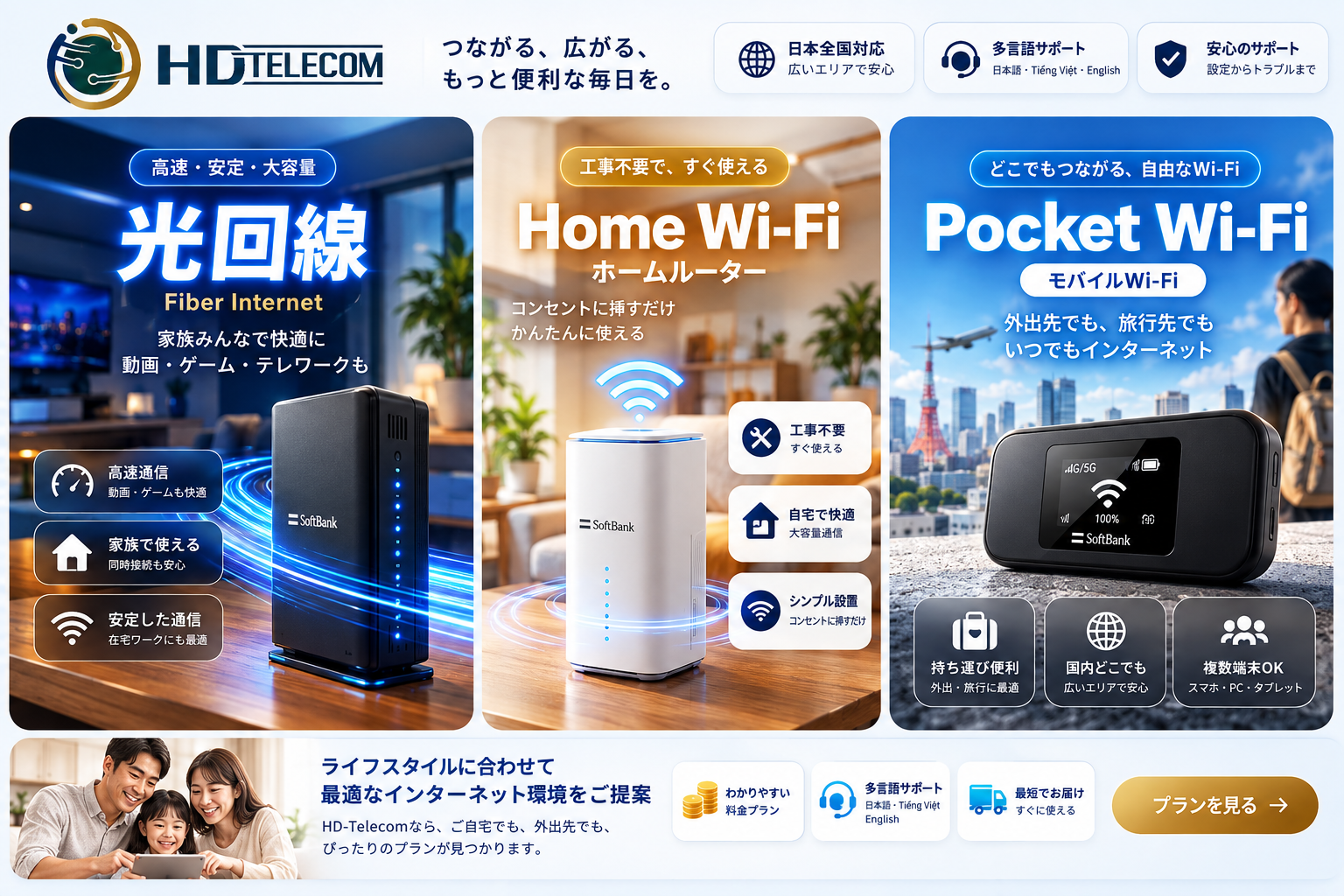
- Monthly Pocket WiFi — Plug and play for the whole room, perfect while waiting for broadband or if your landlord denies installation permission.
- Monthly Data SIM and Monthly eSIM — Fast setup, no long-term contracts.
You can browse our complete product catalog, or visit our support page if you have questions regarding payment methods or bank transfers. We provide full Vietnamese customer support, so please feel free to reach out before purchasing.
Related products
Find your plan with HD TELECOM
SIM, eSIM and Pocket WiFi — genuine quality, clear pricing, 24/7 support.