
Can you open a bank account without a Japanese phone number?
September 3, 2026
Quick Answer
Legally speaking, a phone number is NOT a mandatory identity verification document for opening a bank account in Japan. What's required under the Act on Prevention of Transfer of Criminal Proceeds (犯罪収益移転防止法) is valid identification (residence card, passport) and a residential address in Japan. However, in practice, almost 100% of banks require you to fill in a contact phone number in Japan on the application, and online banks (Rakuten Bank, PayPay Bank, SBI, etc.) require a Japanese mobile number to receive OTP codes via SMS — without it, you cannot complete registration.
Practical conclusion: if you open an account at a counter at Japan Post Bank (ゆうちょ銀行) or a major bank branch, you may be able to temporarily use the landline number of your dormitory, school, or company (with their consent). But the safest and fastest way is to buy a SIM with a Japanese phone number first, then go open the account.
Who This Article Is For
- International students, technical intern trainees, engineers, specified skilled workers who have just arrived in Japan and already have a residence card (在留カード) but no phone number yet.
- People currently using a data-only SIM (network access only, no 090/080/070 number) who have been rejected by banks because they can't receive SMS.
- People stuck in a loop: opening a bank account requires a phone number — but buying a SIM requires a bank card or credit card for payment.
- People who want to know which bank in Japan is easiest to open an account with for newcomers.
Cases Where This Does NOT Apply
- You don't have a residence card yet or haven't registered your address at the ward/city office. Without a valid address in Japan, you cannot open a regular account even with a phone number. Complete the 転入届 (move-in notification) first.
- You entered on a short-term tourist visa (90 days, no residence card). Japanese banks almost never open accounts for tourists.
- You want to open an account to receive salary from a company that already has a designated account. In this case, the company usually specifies a particular bank and sometimes handles the process collectively — check with HR first.
- You need to open a corporate account (公人・法人口座) for a company. The procedure is completely different and not covered in this article.
Steps to Follow
The Right Order to Avoid Getting Stuck
- Receive your residence card (在留カード) at the airport or at the ward office after entering Japan.
- Register your address at the ward/city office within 14 days of moving into your residence. After this step, the address will be printed on the back of your residence card — banks are required to check this section.
- Buy a SIM with a Japanese phone number (voice SIM / 音声SIM). This is the step many people skip, only to have to return to the bank a second time. A 090/080/070 number that can receive SMS is a practical requirement for completing most bank procedures, banking apps, and two-factor authentication.
- Choose the right bank (see comparison table below). Newcomers who have been in Japan less than 6 months should prioritize Japan Post Bank or a local bank near their home/school.
- Visit the bank counter during business hours (usually 9:00–15:00, Monday to Friday), bringing all the documents listed in section 5.
- Fill out the account opening application (口座開設申込書). Write your name in Latin letters exactly as it appears on your residence card; write your address exactly as shown on the back of the card.
- Register your seal or signature (印鑑・サイン). Many banks now accept signatures for foreign residents, but having a personal seal (hanko) is still more convenient.
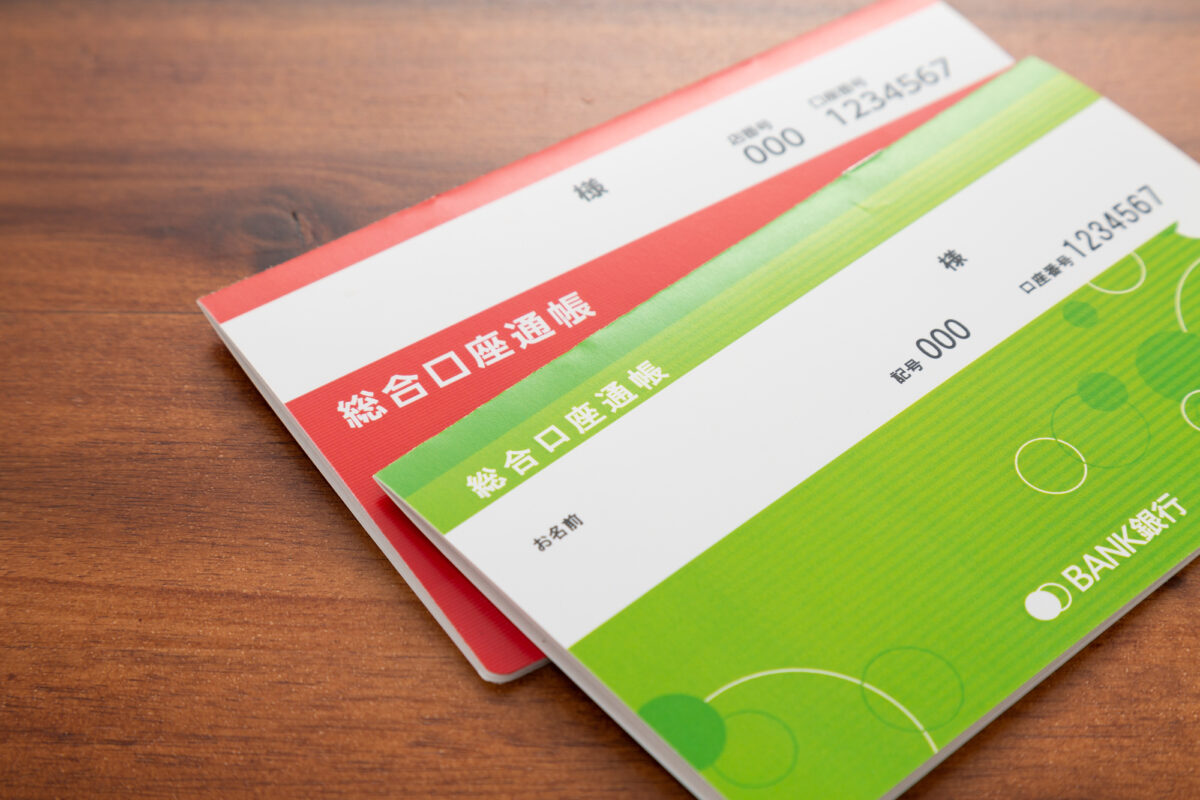
- Receive your bankbook (通帳) on the spot, while your ATM card (キャッシュカード) will be mailed to your registered address after about 1–2 weeks. You must be present to sign for it, or leave a notice and arrange redelivery.
If You Really Can't Get a Phone Number Right Away
- Ask your dormitory, school, or company whether you can use the facility's landline number as a temporary contact number. You must get clear permission, as the bank may call to verify.
- Prioritize opening an account at a counter, not online. The counter process is much more flexible than app-based eKYC (which requires SMS).
- Accept that an account opened this way usually cannot activate internet banking or the app until you update your real mobile number.
- Once you have a SIM, return to the bank or go to the information change section to update your phone number as soon as possible.
Let's be honest: options 1–4 above are stopgap measures. The cost of a voice SIM is far cheaper than missing work, traveling back and forth two or three times, and still not being able to use the banking app.
Documents to Prepare
- Residence card (在留カード) — mandatory, the back must show your current address.
- Passport — many branches require this for cross-checking.
- My Number card (マイナンバーカード) or My Number notification card (通知カード) — required by many banks, especially if you might make international transactions or receive interest.
- Student ID / enrollment certificate (for international students) or certificate of employment 在職証明書 (for workers) — not always mandatory but highly recommended, as it helps explain the reason for opening the account.
- Personal seal (印鑑) if you have one. If not, ask in advance whether the branch accepts a signature instead.
- Contact phone number in Japan — not a "document" but a mandatory field on the application.
- Initial deposit amount — usually just 1 yen or more is enough, but it's advisable to bring a few thousand yen in cash.
Note about your name: the name on the application must match exactly with your residence card, including the order of family name and given name. One character wrong and the bank will return your application.
Costs
| Item | Reference Cost |
|---|---|
| Opening a regular bank account | Free (0 yen) |
| Minimum deposit when opening | From 1 yen (in practice, it's better to deposit 1,000–10,000 yen) |
| Reissuing a bankbook / ATM card if lost | Approximately 1,100 yen per time, depending on the bank |
| Making a personal seal (hanko) | Approximately 1,000–3,000 yen |
| SIM with a Japanese phone number | Depends on the carrier and plan |
| Account maintenance fee | Usually 0 yen; some banks charge a dormant account fee after 2 years of no transactions |
In other words: opening an account itself costs almost nothing. The real cost lies in time and whether you already have a phone number.
Deadlines / Processing Times
- Registering your address at the ward office: within 14 days of moving into your residence. This is a legal deadline and should not be delayed.
- Opening an account at the counter: about 30–60 minutes if you have all the documents. You'll usually receive your bankbook the same day.
- Receiving your ATM card by mail: about 7–14 business days, sent as registered mail requiring a signature.
- Opening an online (internet bank) account: 3–10 days, but you must have a Japanese mobile number from the very first step.
- The "6-month residency" rule: under the Foreign Exchange Act, foreigners who have been in Japan for less than 6 months may be classified as "non-resident" (非居住者) and face restrictions on certain services, especially international money transfers. Because of this, some branches require you to have been in Japan for more than 6 months. If you have a long-term work/study visa along with an employment contract or enrollment certificate, most banks will still open an account normally — be sure to bring proof documents.
Where to Apply / Where to Go
Which Bank Is Easiest for Newcomers?
| Bank | Phone Number Requirement | Ease for Newcomers | Notes |
|---|---|---|---|
| Japan Post Bank (ゆうちょ銀行) | Requires a contact number; more flexible when opened at the counter | Easiest | Available at every post office, with many staff experienced in handling foreign applications |
| MUFG / SMBC / Mizuho | Requires a contact number in Japan | Medium | Some branches require over 6 months of residency; it's best to choose a branch in an area with many foreign residents |
| Local banks (地方銀行), Shinkin banks | Requires a contact number | Medium – Easy | Usually friendly if you live/work near the branch |
| Rakuten Bank, PayPay Bank, SBI, Sony Bank | Requires a Japanese mobile number to receive SMS OTP | Difficult without a SIM | Opened entirely online, no counter option available |
| SBI Shinsei Bank | Requires a mobile number | Medium | Good English interface |
Practical tip: choose a branch located in an area with many foreign residents (Shin-Okubo, Ikebukuro, Ueno, industrial cities with many technical interns). Staff there are already familiar with applications like yours, so processing is faster and there's less chance of unreasonable rejection.
Bring Someone Who Speaks Japanese
Japanese banks rarely have Vietnamese-speaking staff. If your Japanese is still weak, bringing a senpai, teacher, or someone in charge from your company will save you a lot of time. Some major banks have bilingual application forms — try asking "英語の申込書はありますか" (Do you have an English application form?).
Common Mistakes
1. Using a data-only SIM and thinking you already have a phone number
A data SIM (データSIM) only gives you internet access — it has no 090/080/070 number and cannot receive SMS. Many people write their LINE number or Vietnamese number on the application, then fail to receive the verification code and can't activate the banking app. If you need to complete administrative procedures, use a voice SIM with a Japanese number. If you only need internet for study and entertainment, a monthly data SIM is fine.
2. Using an IP-based 050 number to receive OTP
Internet-calling apps that provide 050 numbers are convenient, but many banks and financial services reject 050 numbers for SMS verification. Don't register for online banking using a 050 number.
3. Not registering your address at the ward office
If the back of your residence card is still blank, you're almost certain to be rejected. Complete the 転入届 first, then go to the bank.
4. Writing an address different from your residence card
For example, if your card says "1-2-3" but you write "1丁目2番3号" with a building name that doesn't match — your ATM card may be returned to the post office. Copy the address exactly as written, including the building name and room number.
5. The name on your mailbox doesn't match the registered name
The ATM card is sent by registered mail. If your mailbox doesn't have your name on it, the post office may return the letter to the bank and your application could be canceled. Put your name on your mailbox before waiting for the card.
6. Going to the bank outside business hours
Account-opening counters usually close at 15:00 and are closed on Saturdays, Sundays, and holidays. ATMs being open doesn't mean you can open an account.
7. Stuck in the "need a bank card to buy a SIM" loop
Many major Japanese carriers only accept payment by credit card or direct debit, making it impossible for newcomers to buy a SIM. Solution: choose a provider that allows payment by bank transfer, convenience store, or cash. See payment instructions on the support page.
8. Opening an account and then letting it "sleep" too long
An account with no transactions for several years may be classified as dormant, and some banks charge a maintenance fee. If you're returning to your home country, properly close your account (解約) instead of just abandoning it.
Frequently Asked Questions
Can I open an account at Japan Post Bank without a phone number?
It's possible, if you open the account at the counter and can provide a contact number in Japan (a landline of your school, dormitory, or company) with that party's consent. However, this depends on each branch's decision and isn't a guaranteed option. Having your own mobile number is still the most reliable way.
Can I fill in a Vietnamese phone number?
You shouldn't. The phone number field on the application is for the bank to contact you domestically; foreign numbers are usually rejected by the system, and you also won't receive verification SMS. Accounts opened this way are very likely to have restricted functions.
Can a data SIM receive the bank's OTP code?
No, unless that SIM plan includes SMS functionality. A pure data SIM has no phone number, so it cannot receive SMS. To be sure you can use the banking app, two-factor authentication, register for PayPay, and other services, you should use a voice SIM with a 090/080/070 number.
Can I open an account if I've been in Japan for less than 6 months?
Yes, in most cases, if you have a long-term residence card, have registered your address, and have an enrollment certificate or employment certificate. Japan Post Bank and many local banks handle this fairly easily. Some megabank branches still keep an internal 6-month rule — if rejected, try a different branch or a different bank.
Do I need a bank account before buying a Japanese SIM?
Not necessarily. Some providers accept payment by bank transfer or cash, which suits newcomers who don't yet have a card. This is exactly how to escape the loop of "need a bank to buy a SIM, need a SIM to open a bank account." See payment details on the support page.
After I get a phone number, how do I update it with the bank?
Bring your bankbook, residence card, and seal (or registered signature) to the counter and ask for the 住所・電話番号変更届 form. Some banks allow you to change this directly in the app or internet banking if your account is already activated.
Will there be any impact if I change my phone number?
Yes. The phone number registered with the bank is used to receive OTPs, confirm unusual transactions, and recover passwords. Changing your number without notifying the bank may cause your app to be locked or prevent you from verifying transfers. Update it immediately after changing your number.
Can I open an account entirely online in English?
Some internet banks support an English interface, but all of them require a Japanese mobile number and an eKYC process involving a video call or photographing your residence card. Without a SIM, you won't be able to complete the verification step.
References
- National Police Agency of Japan (警察庁) — Act on Prevention of Transfer of Criminal Proceeds (犯罪収益移転防止法), regulations on identity verification when opening an account: npa.go.jp
- Financial Services Agency of Japan (金融庁 / FSA) — guidelines on account opening and anti-money laundering: fsa.go.jp
- Japan Post Bank (ゆうちょ銀行) — guide page on opening accounts for foreign residents: jp-bank.japanpost.jp
- MUFG Bank, SMBC, Mizuho Bank — official pages on conditions for opening personal accounts for foreign residents.
- Immigration Services Agency of Japan (出入国在留管理庁) — regulations on residence cards and address reporting obligations: isa.go.jp
- Ministry of Internal Affairs and Communications (総務省) — regulations on identity verification when signing mobile phone contracts (携帯電話不正利用防止法): soumu.go.jp
Important note: account opening conditions vary between banks and even between branches, and may change at any time. This article is for reference purposes only, not financial or legal advice. Before going, you should call or check the official website of the bank and the ward office where you live to confirm the latest information.
Source Verification Date
The information in this article was last verified in June 2025. (Editor's note: please update the specific verification date and review official source links before publishing.)
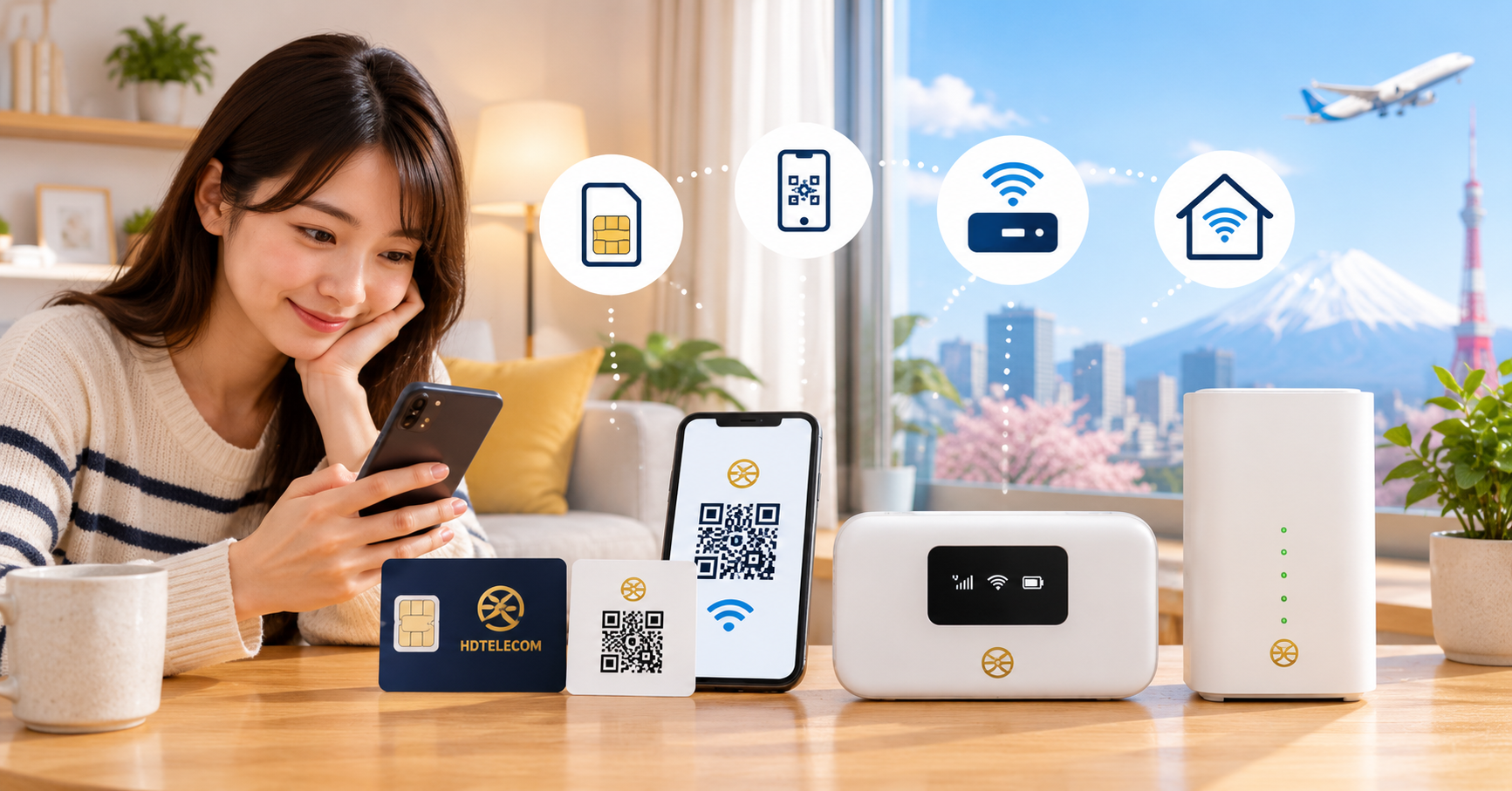
SIM, eSIM and WiFi Plans for Newcomers to Japan
If you've just arrived in Japan, HD TELECOM offers SIM/eSIM plans designed specifically for foreign residents, supporting registration with a residence card and flexible payment options even if you don't have a bank account yet.
- Monthly data SIM or monthly eSIM — if you only need internet and already have your own phone number.
- Portable WiFi — if your whole family or dormitory room shares one device.
Not sure which plan suits you? You can check out all products or message our support team at the support page — consultation in Vietnamese, no pressure to buy. Read more guides for newcomers to Japan on our blog.
Related products
Find your plan with HD TELECOM
SIM, eSIM and Pocket WiFi — genuine quality, clear pricing, 24/7 support.