

A to Z Guide to Studying in Japan: A Comprehensive Guide for Vietnamese
August 18, 2026
Studying abroad in Japan has always been one of the top choices for Vietnamese students aiming to develop their education and expand international career opportunities. However, the journey from the initial spark of intention and application preparation to actually stepping foot at Narita or Haneda airport requires meticulous preparation in terms of finance, language, and mindset.
This article has been compiled by the HD TELECOM team to provide you with a comprehensive, realistic, and up-to-date overview of studying abroad in Japan, helping you confidently build a solid plan for your future.
1. Why should you study in Japan? A practical perspective
Moving past the flashy advertisements of a "pink paradise," the practical reasons why tens of thousands of young Vietnamese decide to study in Japan every year typically revolve around the following core factors:
- Advanced educational environment and globally valued degrees: Japan possesses a system of universities and research institutes with high global rankings, especially in engineering, automation, information technology, biotechnology, and business administration.
- Open career opportunities after graduation: With a rapidly aging population, Japan's labor market is facing a severe shortage of human resources. The Japanese government has been enacting numerous policies to facilitate international students in transitioning to working visas (engineer, humanities, international services) to stay and work long-term.
- Safe and civilized living environment: Japan consistently ranks among the safest countries in the world with low crime rates, public transportation systems accurate to the minute, and exceptionally developed medical services.
- Opportunities to practice independence and discipline: Living and studying in a country that respects discipline, punctuality, and responsibility will help you mature quickly, shaping a professional work ethic—a huge plus in the eyes of any future employer.
To learn more official general information from the Japanese government, you can refer to the Study in Japan portal.
2. Types of schools in Japan and how to choose a pathway according to your goals
The post-secondary education system in Japan is very diverse. Depending on your Japanese proficiency, current education level, financial capability, and career orientation, you can choose one of the following four main pathways:
- Japanese Language Schools (日本語学校 - Nihongo Gakkou): Institutions that teach Japanese from beginner to advanced levels (N5 to N1), while preparing students for the EJU and JLPT exams and honing interview skills so they can advance to vocational schools, universities, or graduate schools.
- Vocational Schools (専門学校 - Senmon Gakkou): Providing in-depth practical vocational training for 2 to 4 years (such as IT, graphic design, hospitality, culinary arts, automotive engineering, nursing). Graduates are awarded a Professional Degree (Senmonshi) and can enter the workforce directly in Japan.
- Universities (大学 - Daigaku): Providing 4-year undergraduate programs (or 6 years for medicine, dentistry, and veterinary medicine). The curriculum combines foundational academic knowledge and specialized research, opening up opportunities to work in major corporations or pursue graduate studies.
- Graduate Schools (大学院 - Daigakuin): Providing Master's (2 years) and Doctoral (3–4 years) programs for those who have graduated from university and wish to pursue in-depth research or advance to management and senior expert positions.
Below is a general comparison table between educational systems to help you easily shape your path:
| Educational System | Study Duration | Basic Admission Requirements | Approximate Tuition / Year | Suitable For Who? |
|---|---|---|---|---|
| Japanese Language School | 1 year 3 months – 2 years | High school graduation, Japanese N5 / NAT-TEST 5Q or higher | About 650,000 – 850,000 JPY/year (depending on the school) | Those who do not have sufficient Japanese proficiency to enter a major directly; want time to adapt to the culture. |
| Vocational School (Senmon) | 2 – 4 years | High school graduation, Japanese minimum N2 or N3 (depending on the field), or completion of a language school | About 800,000 – 1,400,000 JPY/year (engineering and art fields are usually higher) | Those who want to learn practical skills, quickly graduate and work in Japan, focusing on applied skills. |
| University | 4 years (Medicine/Pharmacy: 6 years) | High school graduation, EJU/JLPT N2-N1 certificate, or English certificate (IELTS/TOEFL) for E-track programs | About 550,000 – 900,000 JPY/year (National); 800,000 – 1,600,000+ JPY/year (Private) | Those who want a solid academic foundation, an international bachelor's degree, and deep promotion opportunities in large enterprises. |
| Graduate School | 2 years (Master's), 3-4 years (Doctorate) | University graduation, research plan (Kenkyu Keikakusho), Japanese N1/N2 or good English | About 550,000 – 850,000 JPY/year (National); Private depending on the major | Those with a bachelor's degree who want to conduct in-depth research, advance their academic degree, or teach and do R&D. |
3. Basic conditions & document portfolio to prepare
The study abroad application review process by the Immigration Services Agency of Japan (Nyukan) is famously strict and emphasizes the consistency and transparency of documents. Basically, you need to meet the following conditions:
Regarding academic performance and age:
- Graduated from High School, College, or University.
- High school Grade Point Average (GPA) is generally encouraged to be from 6.5/10 or higher for high application reliability.
- The gap after graduating from the most recent level of education should not exceed 3–5 years without a clear reason or job.
Regarding language proficiency:
- When applying to a language school, you need an introductory Japanese certificate equivalent to N5 (JLPT, NAT-TEST, J-TEST, TOP J exams...) or a confirmation letter of studying at least 150–180 hours of Japanese at a reputable center. You can look up exam schedules and information at the JEES (Japan Educational Exchanges and Services) organization.
- For those applying directly to undergraduate/graduate programs taught in English (English Track / formerly G30 program), an IELTS, TOEFL, or TOEIC certificate meeting each school's specific requirements is needed.
Regarding financial capacity and sponsors:
- The financial sponsor (usually parents or close blood relatives) must prove a stable and legal source of income over the years.
- A bank savings account in the name of the sponsor or student with a balance ensuring tuition and living expenses for the first academic year.
- Financial proof documents include: Employment confirmation letter, salary statement or income tax return statement, property ownership certificate (if any). All information must match absolutely across documents.
4. Step-by-step process to apply for a Japanese "Student" visa
To hold a Japanese study abroad visa in your hands, you need to go through a standard 6-step route as follows:
- Determine goals and choose a school: Research information on schools matching your preferences, geographical location, tuition fees, and intake terms (Japan has 4 intake terms in January, April, July, and October, with April and October being the two main terms).
- Prepare and submit university admission applications: Complete the application portfolio according to the school's requirements including transcripts, diplomas, Japanese certificates, application forms, and the sponsor's financial proof documents.
- The school submits an application for the Certificate of Eligibility (COE): The school will represent you in submitting the complete application portfolio to the local Immigration Services Agency of Japan (Nyukan) to review the Certificate of Eligibility (COE). The review process usually takes 2 to 3 months.
- Receive COE results and pay tuition: Upon notification of COE approval, the school will send a scan of the COE along with the Tuition Invoice. You proceed to transfer tuition directly from a Vietnamese bank to the school's account in Japan.
- Receive the original COE and apply for a Visa: After receiving tuition, the school will express ship the original COE and Admission Letter to Vietnam. You take this application portfolio along with your passport to submit at the Embassy/Consulate General of Japan or through authorized visa application centers (VFS Global).
- Receive visa results and prepare flight luggage: Once granted a study abroad visa, you proceed to book flight tickets, prepare luggage, personal items, and get ready to depart for Japan.
- Japanese Language School: About 650,000 – 850,000 JPY/year.
- National/Public University: About 535,800 – 600,000 JPY/year (plus an initial admission fee of about 282,000 JPY).
- Private University: Ranging from 800,000 to over 1,500,000 JPY/year depending on social sciences, economics, or engineering and medicine majors.
- School dormitories: About 20,000 – 45,000 JPY/month (usually sharing with 2–4 people).
- Renting private housing outside (Apāto): In Tokyo about 50,000 – 80,000 JPY/month; in neighboring provinces or remote areas about 30,000 – 50,000 JPY/month. When renting outside for the first time, you may have to pay additional fees such as key money (Reikin), deposit (Shikikin), brokerage fees, and insurance.
- Food expenses: About 25,000 – 40,000 JPY/month if cooking for yourself; if eating out frequently, costs can rise to 50,000 – 70,000 JPY/month.
- Phone, internet, electricity, water, gas bills: About 10,000 – 18,000 JPY/month.
- National Health Insurance (Kokumin Kenko Hoken): About 1,000 – 2,500 JPY/month for international students without high income (helps cover 70% of medical examination and treatment costs).
- Transportation, personal pocket money: About 5,000 – 15,000 JPY/month (you should take advantage of the Teikiken train commuter pass for students).
- Tuition exemption/reduction scheme (授業料免除 - Jugyouryou Menjo): Many national and public universities have policies to reduce or exempt 30%, 50%, or even 100% of tuition fees for international students with difficult economic circumstances and good academic achievements. You need to submit a separate application for review at the school after enrollment.
- Japanese Government Scholarship (MEXT): Full coverage of tuition and monthly living expenses, applied through the Japanese Embassy in Vietnam or through university recommendation. See more on the website of the Ministry of Education, Culture, Sports, Science and Technology (MEXT).
- JASSO Honors Scholarship: Monthly living expense stipend for self-funded international students with outstanding achievements. Look up details in the scholarship catalog of JASSO (Japan Student Services Organization).
- Scholarships from private funds and localities: Typically like the Rotary Yoneyama Memorial Scholarship, Honjo International Scholarship Foundation, or the Atsumi International Foundation for graduate levels.
- During semesters: Maximum no more than 28 hours/week. This figure applies to the total working hours of all your jobs combined, not 28 hours for each place.
- During the school's official long breaks: (such as summer break, winter break, spring break with a certificate from the school), you are allowed to work a maximum of 8 hours/day (maximum 40 hours/week).
- Waste separation rules (Gomi Bunbetsu): Japanese people separate waste very strictly into burnable waste, non-burnable waste, PET plastic bottles, metal cans, recyclable waste... Each type of waste has its own collection day and time frame. Improper waste disposal can get you reprimanded by your landlord or fined.
- Culture of maintaining public order: On subways and buses, Japanese people always keep quiet, put phones on Manner Mode, and do not make phone calls. Avoid speaking too loudly or playing music out loud when in your room.
- Punctuality (Jikan Genshu): In both study and work, Japanese people consider being late a serious lack of respect. Form a habit of arriving 5 to 10 minutes before the scheduled time.
- Administrative procedures at the City Hall (Kuyakusho/Shiyakusho): Within 14 days of having a stable residential address, you are required to go to the district/city administrative office to register your permanent address on your Residence Card and register to participate in National Health Insurance.
- SIM / eSIM data & calls: Registration procedures are extremely simple using a passport or residence card, receive the SIM right in Vietnam before flying or delivered directly in Japan, with full support in Vietnamese.
- Portable WiFi device (Pocket WiFi) & wireless fixed WiFi: High-speed data volume, no worries about connection disruption when moving house or if wired network installation at your room is delayed.
- Dedicated Vietnamese support team: Always accompanying you, answering all questions about installation, fees, and providing technical support throughout your study and life in Japan.
5. Actual costs: Tuition, living expenses, and housing
Studying in Japan does not have an absolute fixed figure for everyone, because spending levels depend heavily on the city you live in (large metropolitan areas like Tokyo, Osaka, Yokohama will be significantly more expensive than provinces like Fukuoka, Hiroshima, Sendai, or rural areas) and the type of school you attend.
1. Annual tuition fees (relative estimates):
2. Housing costs (rent, dormitories):
3. Monthly living expenses:
Support policies and scholarships:
To ease financial burdens, you should look into scholarship sources and support policies early:
6. Legal part-time work regulations: Permission 資格外活動許可 and the 28-hour limit
The Japanese government allows international students to work part-time (Arubaito) to cover a portion of living expenses, but you must strictly comply with the following legal regulations:
1. Permission to Engage in Activity Other Than That Permitted under the Status of Residence Previously Granted (資格外活動許可 - Shikakugai Katsudō Kyoka):
Upon entry at the airport (Narita, Haneda, Kansai, Chubu...), you need to immediately submit the application form for this permit at the customs clearance counter. The customs officer will stamp the certification directly on the back of your Residence Card (Zairyu Card). Without this stamp, working part-time is completely illegal.
2. Regulations on working hours:
3. Absolutely banned industries:
International students are strictly prohibited from working in adult entertainment establishments (Fuzoku), bars, pubs with hostesses, pachinko parlors, mahjong parlors, or jobs related to gambling or prostitution—including doing auxiliary tasks like dishwashing or cleaning at these locations. Violators will be deported back to their home country immediately.
Important note: Overworking (working beyond regulated hours) is the leading cause for many international students being denied visa extensions or denied transitions to working visas after graduation. Always put your studies first and manage your time scientifically.
7. Life & advice on integrating into Japanese culture
To make your study abroad years in Japan a memorable and smooth experience, you should mentally prepare and get used to the local lifestyle in advance:
Opening a bank account: When first arriving, most international students will open an account at Japan Post Bank (Yucho Ginko) because the procedures are the simplest and most convenient for newcomers residing for under 6 months.
8. Prepare to connect to the Internet from day one in Japan with HD Telecom
During the first few days upon landing in Japan, a phone with a stable internet connection is your survival tool. You will need internet immediately to check maps to find your way to the train station and dormitory, translate Japanese instruction signs, contact family to report safety, and complete residence registration procedures at the City Hall and phone number registration with the school.
Understanding the initial bewilderment of new international students, HD TELECOM brings specialized telecommunications connectivity solutions for foreigners in Japan:
Preparing a SIM card or WiFi device from HD TELECOM in advance will help your first day stepping foot in the land of cherry blossoms be less bewildering and start more smoothly than ever!
Related products
Find your plan with HD TELECOM
SIM, eSIM and Pocket WiFi — genuine quality, clear pricing, 24/7 support.
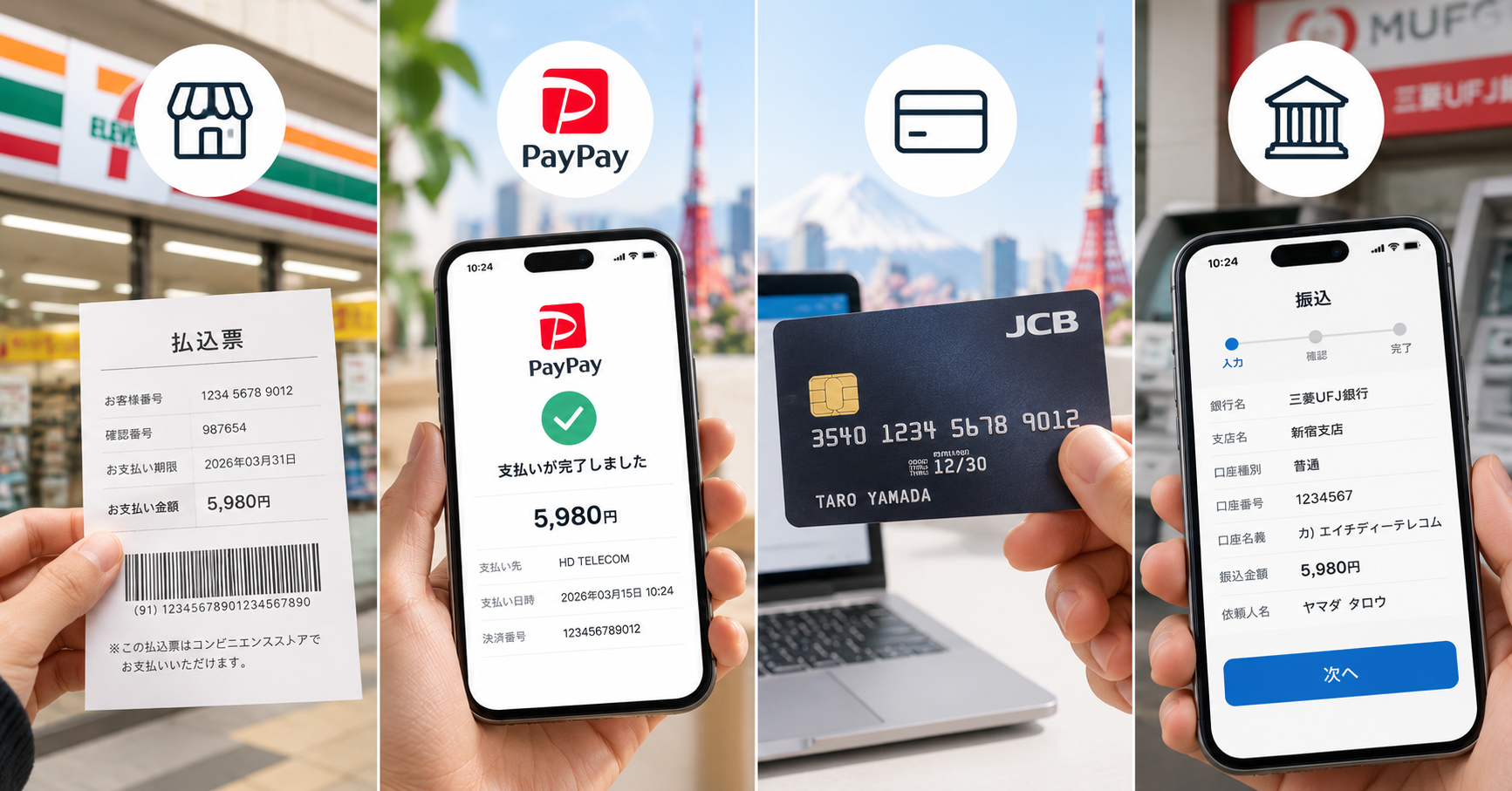
Paying in Japan: What's the difference between combini, PayPay, cards, and bank transfers?
A-to-Z Guide to Winning Study Abroad Scholarships in Japan for Vietnamese Students

Registering a SIM in Japan Without a Credit Card: 4 Payment Methods for Newcomers
Vietnamese Newcomers to Japan: A to Z Guide to Choosing a SIM Card (2026)