
Which SIM Card Should You Buy in Japan? Major Carriers vs. Budget SIMs (MVNO)
October 2, 2026
1. Quick Answer: Major Carriers or Budget SIMs when moving to Japan?
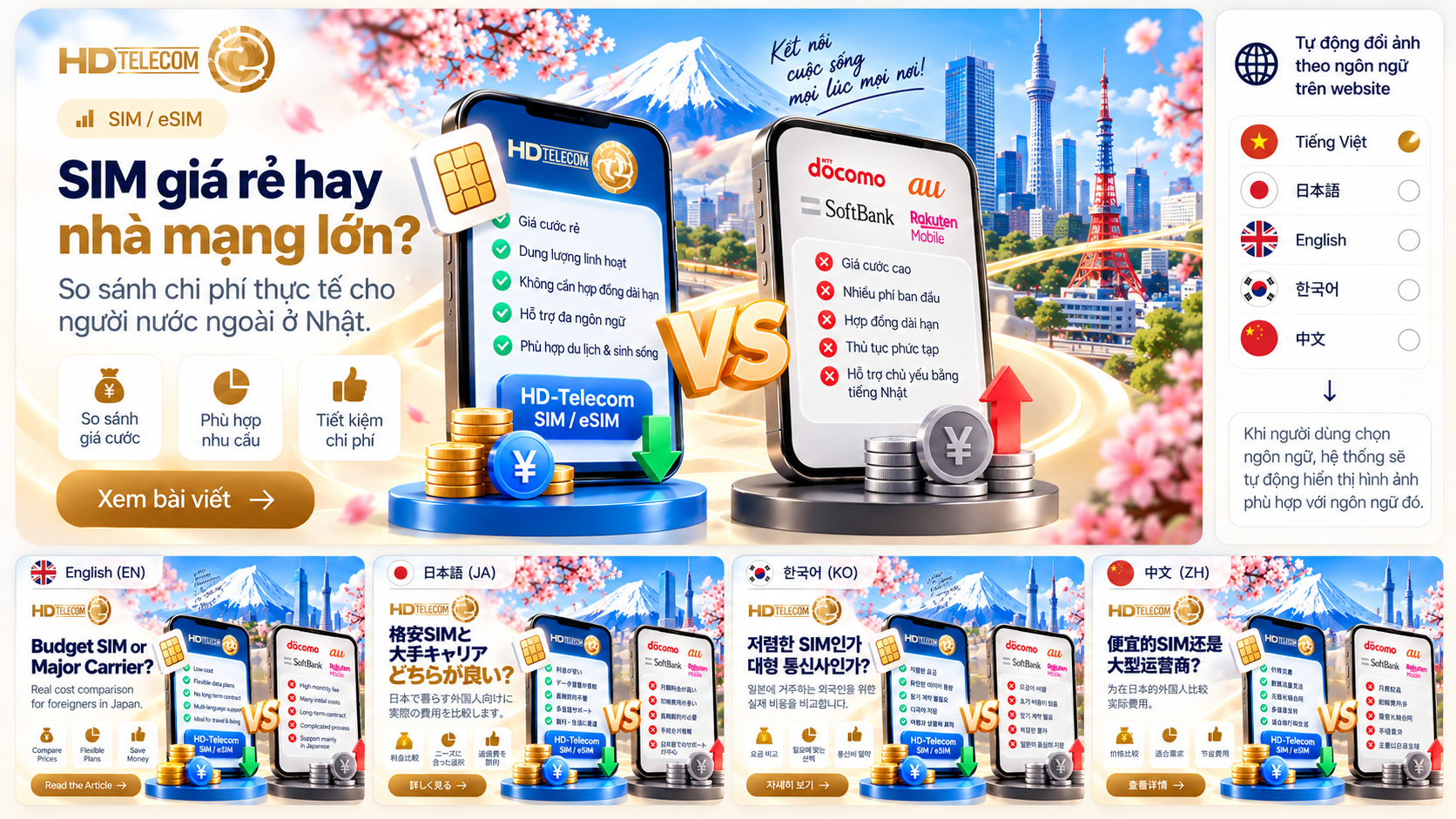
If you have just arrived in Japan and want to maximize cost savings, with simple procedures that require no credit card or 2-year contract lock-ins, a Budget SIM (Kakuyasu SIM) or dedicated Data SIM is the optimal choice. Monthly fees for budget SIMs range only from 1,500 JPY to 3,500 JPY, which is less than half the price of major carriers.
Conversely, you should only sign up with the top 3 major carriers (Docomo, au, SoftBank) if you need unlimited network data, require extremely high speed at all hours of the day, or if your company/school mandates a traditional voice call phone number (070/080/090) registered under your name with a long-term contract. However, monthly costs with major carriers are very high, ranging from 6,000 JPY to 9,000 JPY, accompanied by strict screening procedures and early contract termination penalties.
2. Who is this article for?
This article is compiled to provide accurate, practical information for the Vietnamese community living or planning to live in Japan, including:
- International students, technical trainees, engineers, and Tokutei Ginou workers preparing for entry or recently arrived in Japan within the first 1-3 months.
- Vietnamese living in Japan who want to switch plan rates because the monthly cost of major carriers is a financial red flag.
- People without a Japanese credit card who face difficulties registering for local telecom services.
- People who lack confidence in their Japanese language skills to independently visit Docomo, au, or SoftBank stores to make transactions.
3. Cases where this DOES NOT apply
The comparisons and guidelines in this article are not suitable for the following groups:
- Short-term tourists staying under 15 days (in this case, short-term travel eSIMs or travel Wi-Fi should be used).
- People who need fixed fiber-optic internet (Hikari) installation for an entire family or a large office.
- People doing specialized work requiring massive upload/download bandwidth continuously 24/7, such as professional streamers or server systems engineers.
4. Steps to choose and register the right SIM in Japan
To choose the SIM type that best fits your personal situation and avoid wasting money, you should follow these 5 steps:
- Accurately identify your usage needs: Do you need a traditional calling number (to receive calls from banks, administrative offices), or do you only need Data for internet access and making calls via Zalo, LINE, or Messenger? In fact, 80% of Vietnamese in Japan currently only use Data to communicate via apps.
- Check your device status (Phone): Phones brought from Vietnam must be International models or network unlocked (SIM Unlocked). Carrier-locked phones (SIM Lock) will not accept SIM cards from other carriers.
- Check your available payment methods: Do you have a Japanese credit card, a Yucho bank card, or only cash? Major carriers strictly require payment via a credit card or a bank card under your own name. If you only have cash, you need to find providers that support payments via convenience stores (Combini) or bank transfers.
- Select a SIM format: Do you want to use a physical SIM (delivered to your home) or an eSIM (activated via QR code in 5 minutes)? Note that eSIM requires a phone model that supports this feature (iPhone XS and above or modern Android models).
- Proceed with registration and APN configuration: After receiving the physical SIM or eSIM QR code, you need to configure the APN (Access Point Name) settings according to the provider's instructions for your device to catch network signals in Japan.
5. Required documents when signing up for a SIM in Japan
Telecom regulations in Japan are very strict to prevent telephone fraud. Depending on the type of SIM you choose to register, document requirements will differ significantly:
| SIM Service Type | Required Documents | Payment Account Requirements |
|---|---|---|
| Major Carriers (Docomo/au/SoftBank) (SIM with 070/080/090 calling numbers) |
- Residence Card (Zairyu Card) valid for more than 2 years (or depending on contract length). - Valid Passport. - Certificate of Residence (Juminhyo) issued within the last 3 months. |
Personal Credit Card or Japanese Bank Account (Yucho, MUFG...) setup for auto-debit. |
| Local Budget Carriers (Y!Mobile, UQ, Rakuten, Ahamo) |
- Residence Card (Zairyu Card) clearly showing current residential address. - Passport. |
Most require a Credit Card. A few accept Debit cards or Yucho bank. |
| Data SIM / eSIM dedicated services for foreigners |
- Residence Card (Zairyu Card) or Passport. - Simple and fast approval process. |
Flexible: Cash via Combini, Bank Transfer, ATM Card, Credit Card. |
6. Detailed Cost and Speed Comparison: Major Carriers vs. Budget SIMs
This is the most crucial section to help you picture your monthly financial commitments when using telecom networks in Japan. Many Vietnamese newly arrived are often shocked by their first month's bill from major carriers due to not fully understanding hidden fees.
6.1. General comparison table between telecom models in Japan
| Comparison Criteria | Top 3 Major Carriers (Docomo, au, SoftBank) | Secondary Carriers / Sub-brands (Ahamo, UQ, Y!Mobile) | Budget SIMs (Kakuyasu SIM / Data SIM) |
|---|---|---|---|
| Monthly Fee (Average) | 6,000 JPY - 9,500 JPY (~1,000,000 - 1,600,000 VND) |
2,100 JPY - 4,000 JPY (~350,000 - 680,000 VND) |
1,500 JPY - 3,200 JPY (~250,000 - 540,000 VND) |
| Initial Setup Fee (Jimu Tesuryo) | 3,850 JPY | 3,300 JPY - 3,850 JPY | 0 JPY - 3,300 JPY (Varies by promotion) |
| Peak Hour Speed (12 PM - 1 PM, 6 PM - 8 PM) | Extremely stable (100Mbps - 300Mbps) | Very good (50Mbps - 150Mbps) | Decent (10Mbps - 40Mbps), sufficient for web browsing, HD video. |
| Coverage Infrastructure | Owns independent network infrastructure, 99% coverage across Japan. | Shares infrastructure of parent companies (Docomo/au/SoftBank). | Leases lines from Docomo or SoftBank. |
| Credit Card Requirement | Mandatory (or Japanese bank account) | Mostly requires Credit Card | Not mandatory (supports Combini/Bank Transfer) |
| Contract Lock-in | Usually 1 - 2 year contracts. Early cancellation fees apply. | No contract or 1-year contract. | No long-term commitment, flexible month-to-month. |
6.2. Detailed analysis of peak hour network speeds
Budget SIMs (MVNOs) operate on a mechanism of leasing a fraction of bandwidth from major players like Docomo or SoftBank. Imagine the internet pipeline as a highway: major carriers own 4 spacious lanes of their own, while budget SIM companies only lease 1 lane.
During peak hours — especially lunch hour (12:00 - 13:00) when millions of people pull out their phones at once, or rush hour (18:00 - 20:00) on trains — budget SIM bandwidth gets throttled slightly. Speeds may drop to 5 Mbps - 15 Mbps. This speed is still sufficient for Zalo messaging, news reading, Facebook browsing, or watching TikTok videos at standard resolution, but if you want to watch 4K movies or play online fighting games that demand ultra-low ping, you will notice slight latency.
6.3. Breakdown of actual costs after 1 year of usage
Let's do a simple financial calculation for 1 year of living in Japan:
- If using SoftBank/Docomo: 7,500 JPY/month x 12 months + 3,850 JPY (initial fee) = 93,850 JPY/year (approx. 16 million VND).
- If using a budget Data SIM: 2,200 JPY/month x 12 months + 0 JPY (promotional setup fee) = 26,400 JPY/year (approx. 4.5 million VND).
Thus, choosing a budget SIM helps you save over 67,000 JPY (approx. 11.5 million VND) every year. This is a significant amount of money for technical trainees and international students to cover rent or living expenses.
7. Contract terms and processing time
Contract issues and waiting times are major hurdles for newcomers to Japan:
- At major carrier stores: You must make an advance appointment (来店予約), travel directly to the store, and wait in line. Processing time takes from 1.5 to 3 hours. The entire transaction is conducted in specialized Japanese telecom vocabulary. If your visa has less than 2 years remaining, many stores will refuse device installment plans or deny signing up for promotional plan contracts.
- At budget SIM services specializing in Vietnamese customers: The registration process is 100% online or done directly at support offices in Vietnamese (such as the Shin-Okubo area, Tokyo). Applications are approved within 15-30 minutes. The SIM or eSIM will be activated on the same day or sent via post to your doorstep within 1-2 business days.
8. Where to get a SIM and registration methods in Japan
Depending on your needs and language proficiency, you can choose one of the following registration channels:
- Directly at carrier Showrooms (Docomo Shop, au Shop, SoftBank Store): Suitable if you have good Japanese (N2 or above), already have a credit card, and want to own a traditional phone number along with the latest phone model purchased on installments.
- Major electronics retail centers (Bic Camera, Yodobashi Camera, Yamada Denki): These centers host counters for many budget SIM brands such as UQ Mobile, Y!Mobile, Rakuten Mobile. Sometimes there are Vietnamese or Chinese staff to assist, but future post-sales customer support remains in Japanese.
- Register through reputable telecom services for Vietnamese (HD TELECOM): This is the safest and most convenient solution for newcomers. You receive 100% consultation in Vietnamese, choose from monthly data SIM or monthly eSIM plans without needing a credit card, support cash payment via Combini, and receive the SIM directly at home.
9. Common mistakes that cause Vietnamese to lose money unnecessarily
While living in Japan, many people have fallen into the following costly traps:
- Bringing a network-locked phone from Vietnam: Phones locked to Vietnamese network providers or locked imported devices will not accept Japanese SIMs. Make sure your device is an International version or request your Vietnamese carrier to Unlock it before flying.
- Not carefully reading automatic contract renewal clauses (Auto-renewal): Many carriers stipulate 2-year contracts. When the 2 years end, if you do not actively cancel during the exact "Renew Month", the contract will automatically renew for another 2 years. If you cancel in any other month, you will be penalized with a contract cancellation fee of 10,000 JPY to 15,000 JPY.
- Confusing calling SIMs with Data SIMs: Many people insist on registering for an expensive calling SIM simply thinking "I must have a 070/080/090 number to live in Japan." In reality, if you only communicate with family and friends via social media apps, a 12-month prepaid data SIM helps you save a fortune while keeping you continuously connected online.
- Incurring out-of-package Data charges: Some major carrier plans automatically purchase extra data at extremely expensive rates (1,000 JPY per 1GB) once your high-speed allowance runs out. The final monthly bill can skyrocket to tens of thousands of Yen.
10. Frequently Asked Questions (FAQ)
Can I buy a budget SIM in Japan without a credit card?
Yes. If you don't have a credit card, you can still register for Data SIM lines or pocket WiFi through providers that support cash payments at convenience stores (Combini) or bank transfers via Yucho bank.
Is a voice calling phone number (070, 080, 090) mandatory while living in Japan?
It is not mandatory in all cases. A traditional phone number is only truly necessary when signing a apartment lease contract under your name, opening a local bank account (like MUFG, SMBC), or registering for complex administrative services. For general communication needs and app account creations, you can completely rely on a Data SIM combined with internet calling applications.
Is budget SIM speed fast enough for streaming movies or gaming?
Completely sufficient. The average speed of a budget SIM ranges from 15 Mbps to 50 Mbps, comfortably allowing you to stream Full HD videos on YouTube, TikTok, browse Facebook, and make smooth Zalo video calls. Only during lunch peak hours (12 PM - 1 PM) might the speed slow down slightly.
Can I keep my old phone number when switching from a major carrier to a budget SIM?
Yes. You can use MNP (Mobile Number Portability) service to switch carriers while keeping your number. You need to request an MNP reservation number (MNP予約番号 - MNP Yoyaku Bango) from your old carrier and provide this code to your new carrier upon registration.
How does an eSIM differ from a regular physical SIM? Which phones support eSIM in Japan?
eSIM is a digital SIM built directly into the phone hardware; you don't need to insert a SIM tray or wait for postal delivery, simply scan a QR code to activate. Popular eSIM-supported models include iPhone XS/XR and above, Google Pixel 3 and above, and modern high-end Android models.
11. Reference Sources
Information in this article was compiled and cross-checked from official sources of the government and telecom corporations in Japan:
- Ministry of Internal Affairs and Communications of Japan (MIC): soumu.go.jp
- NTT Docomo Group: docomo.ne.jp
- KDDI Group (au): au.com
- SoftBank Group: softbank.jp
12. Source Verification Date
All information regarding pricing rates, legal regulations, and telecom procedures in this article was verified and updated accurately by our editorial team in March 2025. Telecom regulations in Japan may change over time, so you should check directly with the provider at the time of registration.
13. Simple, economical Internet solutions for Vietnamese in Japan from HD TELECOM
If you have just arrived in Japan, lack a credit card, face language barriers, and want immediate internet access without suffering hidden costs or complex contract lock-ins, HD TELECOM is ready to assist you.
We specialize in providing optimal Internet connectivity solutions for the Vietnamese community in Japan, with our direct office located in Shin-Okubo, Tokyo:
- Simple procedures: 100% registration in Vietnamese, requiring only a Residence Card or Passport.
- Flexible payments: Cash payments supported via Combini (Lawson, FamilyMart, Seven-Eleven) or bank transfer.
- Diverse products: Explore our complete list of products including high-capacity monthly data SIMs, super-fast activation monthly eSIMs, or monthly pocket WiFi devices to share across multiple devices.
- Dedicated support: A team of Vietnamese advisors offering continuous technical support throughout your service usage in Japan. Visit our support page today to resolve any questions.
Visit the HD TELECOM blog page to read more helpful experience articles about living, studying, and working in Japan!
Related products
Find your plan with HD TELECOM
SIM, eSIM and Pocket WiFi — genuine quality, clear pricing, 24/7 support.